


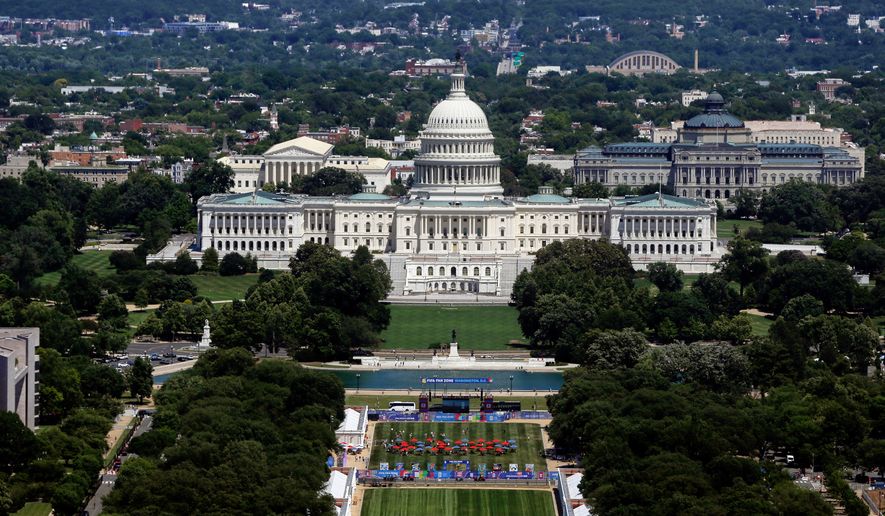

Tourism during 1976, America’s bicentennial, famously underperformed expectations for the nation’s capital, but D.C. insiders say this summer’s 250th birthday party will do better.
The Trust for the National Mall expects nearly 50 million people from around the world to visit America’s most-frequented green space in 2026, up from about 36 million in a typical year.
That would be significantly higher than 50 years ago, according to a 1977 Washington Post report. It found that only 16.8 million of an expected 40 million visitors came to Washington for the much-hyped bicentennial.
The same article noted that D.C. hotel occupancy was just 68% and hoteliers called 1976 “terribly disappointing,” confirming that the 200th birthday celebration drew few spectators from beyond the metro area.
A June 1976 planning memo archived in the Gerald R. Ford Presidential Library and Museum cited a “general opinion” that a July 3 bicentennial parade and Independence Day fireworks would “not produce a large flow of out-of-town visitors.”
The Post reported that 500,000 people watched the parade and up to 1 million viewed the fireworks from the Mall and Tidal Basin, making them the best-attended events of 1976.
This year, the White House expects “more than a million people” to watch fireworks at the National Mall on July Fourth, surpassing the crowd in 1976.
Most D.C. analysts think the projections will hold firm this time, despite a lack of enthusiasm among locals upset about the Trump administration’s government downsizing and immigration crackdowns.
“A narrative that’s caught on around the country is that the city’s safer and more beautiful under Trump than in previous years, even though people here don’t agree,” said Nelson Rimensnyder, 82, an unofficial D.C. historian who worked with the House Committee on the District of Columbia in 1976.
“So I do think there’s going to be more outsiders coming than 50 years ago, even though local residents don’t think we have a lot to celebrate,” he added in a phone interview.
Several analysts highlight decades of population growth, a fuller calendar of events and an expanded tourist infrastructure as reasons to expect a banner summer for the District’s hotels, restaurants and museums.
Dinesh Kumar, a D.C. tourism expert and co-founder of the online travel guide FerryHost, notes that Americans were more inclined to celebrate locally than travel 50 years ago.
“Most Americans wanted to travel to more familiar domestic locations,” Mr. Kumar said. “This is because there weren’t as many hotels, there was no D.C. Metro system, the American public had low awareness of the full scale of the events, and the cost of travel during the economic downturn after Vietnam had increased.”
The D.C. Metrorail played little to no role in the bicentennial commute. It opened in March 1976 on a single 4.6-mile segment of the Red Line, with just five stations operating between Farragut North and Rhode Island Avenue.
Mr. Kumar predicts that the District will see bigger crowds this year. He points out that the city now offers 200 hotels, Airbnb accommodations, larger airports, ride-sharing services and an expanded Metro system.
He also points to a larger number of museum programs and a yearlong schedule of events, such as the Great American State Fair, a national exposition running on the Mall from June 25 to July 10.
Other planned events include the Freedom 250 Grand Prix Formula One race and the National STEM Festival, a youth talent expo that the Education Department will host downtown next week.
Destination DC, the city’s tourism bureau, estimates that the nation’s capital had 27.2 million visitors in 2025, up 20,000 from the previous year. Visitors spent a record $11.9 billion, a 4% increase from 2024.
Destination DC spokesman Kyle Deckelbaum said it’s impossible to estimate how much money America250 will bring to the city this year. But he cites a higher-than-usual volume of group trips, marketed tours, hotel packages, citywide conventions and major weekend events as reasons to expect a spending surge.
“We are seeing potential for a promising summer season in Washington, DC,” Mr. Deckelbaum said in an email.
Hotel boom
The high point of this year’s celebration will be the July Fourth anniversary of the 1776 signing of the Declaration of Independence — the nation’s official birthday.
The CoStar Group, parent company of the hotel industry researcher STR, tracked a 14.4% year-over-year increase in D.C. room bookings for the Fourth of July as of June 8.
“The increase is a sign of continued leisure customer interest in the celebration surrounding the 250th anniversary,” said Jan Freitag, CoStar’s national director of hospitality analytics. “We expect the forward-looking data to strengthen considerably the closer we get to that weekend.”
Yet some analysts have warned of a possible dip in international tourism due to the Trump administration’s travel restrictions, building on a trend that Destination DC flagged last year.
Destination DC estimated that international tourism declined 4% to 2.1 million visitors in 2025.
According to some experts, the presence of National Guard troops and the likelihood of anti-Trump protests could heighten fear of political instability among international travelers.
Even so, they said it’s unlikely such concerns will reduce America250 travel to levels of 1976 or even 2025.
Air travel comparison
Airlines for America, a trade group representing the nation’s major carriers, estimates that in 1976, Washington National Airport handled 12.3 million passengers and Dulles International Airport had 2.8 million.
The Metropolitan Washington Airports Authority, which oversees both facilities, reported that a record-high 53.9 million passengers flew through both airports last year. That included 24.9 million travelers at Reagan National and over 29 million at Dulles.
Airline analysts insist that not even flight disruptions caused by scheduled flyovers and pyrotechnics on Independence Day weekend will force D.C. air traffic back to 1976 levels.
Robert W. Mann, a former American Airlines executive who started working at the carrier in 1977, notes that the U.S. population has grown from roughly 221 million people during the bicentennial to 345 million today.
He also stresses that the nation’s economy is much larger and leisure air travel far more popular than it was 50 years ago, bolstering the likelihood of increased D.C. bookings.
“The population is larger, so if even a fraction visits D.C., you’ll expect a larger crowd than 1976,” said Mr. Mann, an independent airline consultant in Port Washington, New York. “We have an administration that thinks big, and there’s a brand-new Lincoln Memorial Reflecting Pool, so there’s no reason to believe there wouldn’t be more demand.”
The auto club AAA estimated Wednesday that a record-high 72.2 million Americans will travel at least 50 miles from home for Independence Day between Saturday, June 27, and Sunday, July 5.
That includes 5.85 million air passengers, an increase of 20,000 from last year.
“President Trump is ensuring that America gets the spectacular 250th birthday it deserves,” White House spokesman Davis Ingle said Wednesday in an emailed statement. “Between the Patriot Games, Great American State Fair, UFC Freedom 250, and other exciting events, 2026 will feature a renewal of patriotism and national pride under this President’s leadership, and everyone wants to be here to witness it.”
Contact the author


Please read our comment policy before commenting.