



OPINION:
In “Why We Want You To Be Rich,” published in 2006, President Trump explained that a master negotiator knows “what the other side wants and where they’re coming from” and is “never afraid to walk away from a bad deal.”
Henry Kissinger, writing three months earlier about the clerical dictatorship in Tehran, suggested otherwise: “A modern, strong, peaceful Iran could become a pillar of stability and progress in the region. This cannot happen unless Iran’s leaders decide whether they are representing a cause or a nation — whether their basic motivation is crusading or international cooperation.”
In truth, Iranian rulers made that decision the moment they seized power in 1979. Ayatollah Ruhollah Khomeini led what he called the Islamic Revolution.
Never did he or his acolytes exhibit the slightest hint that Kissinger’s vision of “stability, progress, and international cooperation” held any appeal for them.
We Americans can be slow learners.
Last week, a “senior administration official” echoed Kissinger: “We’re also going to see whether the Iranians care more about their economic prosperity than they do their nuclear weapons program, because if they do, the President has instructed us to construct the kind of sanctions relief that would really integrate Iran into the 21st century economy, but they’re only going to get that if they make the real commitment that we need on their nuclear weapons program and on being a regional partner for peace.”
In truth, American diplomats have been talking not to “Iranians” but to mediators for the Khomeinists who have immiserated most Iranians, tens of thousands of whom they slaughtered just this January.
Can anyone seriously believe they care about economic prosperity?
The Iranians who were murdered did want better lives and an end to the jihad against the “Great Satan” (America) and the “Little Satan” (Israel), both of which would love to be their friends.
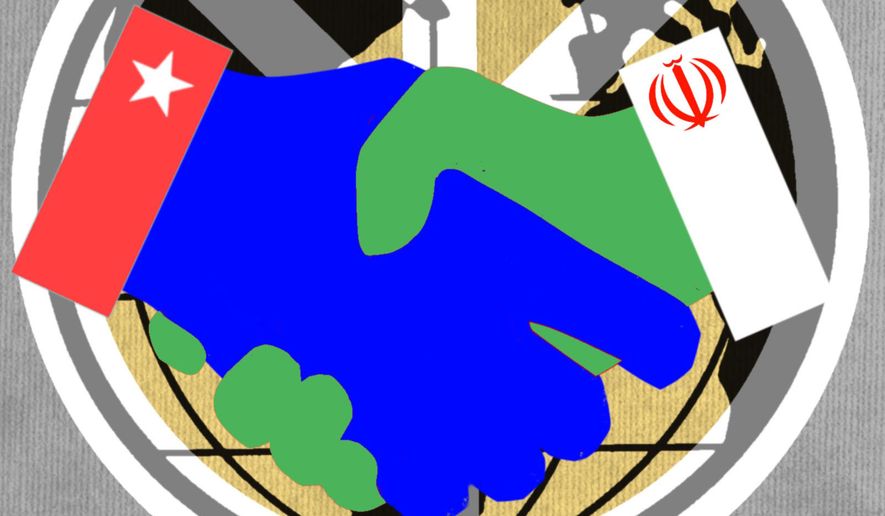
On Sunday, a memorandum of understanding was announced. It is to be finalized Friday in Switzerland, and 60 days of further talks are to follow. That makes me nervous. Iran’s rulers never win on battlefields, but I cannot recall them ever losing in negotiations.
Last year, Abbas Araghchi, the Iranian foreign minister, published the English-language version of his own book on deal-making: “The Power of Negotiation: Principles and Rules of Political and Diplomatic Negotiations.”
He made clear that if a diplomatic outcome is more important to Washington than to his regime, then his regime will prevail.
Among his principles: Appear patient and confident, and make the Americans seem desperate. “The Iranian negotiation style is generally known in the world as the ’market style,’” he wrote, “which means continuous and tireless bargaining.” Over time, opponents grow weary.
At a book launch in December, Mr. Araghchi pointed out that during the June 2025 conflict, Mr. Trump called on Tehran to “unconditionally surrender.”
Ultimately, however, the big guy in the White House agreed instead to an unconditional ceasefire, which is why the 12-day war ended while there were still high-value Iranian military targets to strike.
The same thing happened this year. After 38 days of Operation Epic Fury, Mr. Trump declared a ceasefire in exchange for a promise from Iran’s rulers to stop striking commercial shipping in the Strait of Hormuz. That promise was immediately broken.
Mr. Trump extended the ceasefire to make room for diplomacy, but alternating between diplomacy and force is a mistake.
Skilled negotiators combine the two. Mr. Araghchi correctly explains: “War and negotiation are two sides of the same coin, and that is why negotiation is sometimes described as ’war by peaceful means.’”
Ebrahim Azizi, a former Islamic Revolutionary Guard Corps commander and now head of the parliament’s National Security and Foreign Policy Committee, confirmed this approach forthrightly to CNN a few days ago: “We have said many times that we accept a negotiation as a continuation of the battlefield.”
Nothing I have said here should be mistaken for sympathy with those who claim that “Iran is stronger now” than when Joseph R. Biden lived in the White House.
What Mr. Trump has accomplished cannot be gainsaid. Experts estimate that before the 12-day war, Iran’s rulers were weeks away from a nuclear weapons breakout. They were building missiles and drones by the thousands while lavishly funding and arming their proxies, including Hezbollah in Lebanon and the Houthis in Yemen.
Today, Iran’s rulers have no operating enrichment plants, most of their already enriched uranium is believed to be under tons of rubble, and more than 85% of their defense-industrial base has been destroyed.
What Mr. Trump has achieved to date is what the Israelis call “mowing the lawn.” It is a treatment, not a cure, but treating is preferable to the two alternatives American leaders have chosen in the past: pretending a bad deal is a good one or ignoring a metastasizing problem in the hope it resolves itself.
Both of those approaches bring “endless wars.”
Mr. Trump would be well-advised to now do what his books on deal-making suggest: Put on the pressure. Iran’s rulers need to believe he will resume both the naval blockade and military operations if the coming talks are unproductive.
If the regime in Tehran is weakened, not strengthened, ordinary Iranians may eventually have a chance to rid themselves of despots such as Ayatollah Mohsen Araki, a top member of Iran’s Assembly of Experts.
Last week, he told the semiofficial Mehr News outlet: “America is a hostile infidel enemy, and jihad against it with all one’s strength is obligatory for every free and faithful believer who adheres to the rulings of Islam.”
By now, this should be obvious: The Islamic republic is not and does not intend to be a “partner for peace.”
• Clifford D. May is the founder and president of the Foundation for Defense of Democracies, a columnist for The Washington Times and host of the “Foreign Podicy” podcast.
Follow the author

Please read our comment policy before commenting.