



Like many of you, I suspect, I learned how to play chess as a young boy from my father.
Ben F. Sands Jr. was never more than a casual player, his chess “library” consisting of one old Fred Reinfeld introductory manual. As I grew serious and then obsessed with the game, I quickly surpassed him in skill, and we rarely played head-to-head games after that. His main — and indispensable — contribution to my chess life after that was to ferry me and my friends for years to recreation halls and dodgy hotels across the greater Washington area for weekend Swisses and quads before I finally got my driver’s license.
Chess is not big on dynasties. Immortals such as Morphy and Capablanca learned how the knight moves and how to castle from fathers who were not much better than my own dad. Still, with Father’s Day approaching, it is a good time to reflect on how the simple act of a father sharing his passion for the game can provide a son or daughter with a lifetime of mental stimulation, personal accomplishment and even — if you’re lucky — a modestly paying gig as a weekly chess columnist.
Pushy chess parenting, as depicted in books such as “Searching for Bobby Fischer,” isn’t unknown, but in my experience, chess fathers are gently supportive of their progeny, happy their children have found something that makes them happy.
Henrik Carlsen could serve as a role model in this regard. The father of Norwegian world champ Magnus Carlsen, the engineer and chess expert, talks often of how he tried to support his prodigious son’s talent without ever pushing him to compete or overlooking the needs of his son’s two sisters. Henrik, who at one time boasted a rating of over 2000, even took a point from his then 9-year-old son in an entertaining clash from a tournament in 2000.
In this Queen’s Indian, a more mature Magnus undoubtedly would not have fumbled away a pawn on 6. Bf4 Nbd7?! (Bd6 is indicated here) 7. Nb5 Rc8 8. Nxa7, putting Black on his heels for the rest of the game. Henrik’s edge only grows after 10. Rc1 Nh5?! (c6 11. Nd6+ Bxd6 12. Bxd6 Ne4 13. Bf4 dxc4 15. Rxc4 c5 limits the damage) 11. Bxc7 Rxc7 12. Nxc7+ Qxc7 13. cxd5 Qd8 14. dxe6 fxe6 15. Qb3 — White has three pawns and a rook for two minor pieces, while Black still has some major defensive liabilities to address.
Nice is White’s 18. e4! Bxe5 19. dxe5 Bb7 20. Bb5, setting up a debilitating pin on the d7-knight that Black never fully resolves. Magnus manages to “save” the piece on 23. Qd6 Ke8 24. Qxe6+ Qe7 25. Qd6 (Qg4 was probably even stronger here) Qxd6 26. Rxd6 Ke7 27. Bxd7 Bxd7 28. g3, but White’s material edge has grown by two pawns and Black’s scattered pieces can barely organize a defense.
The White pawns’ inexorable advance leads to an amusing finale: 38. e6 Nf6 39. e7 Bf7 40. Rd8+ Kb7 41. Rxc7+ Kxc7 42. e5 Ne8 43. e6!, and the son concedes to the father since after 43…Bg6 44. f5 Bh5 45. g4!, either the Black knight or bishop will be lost.
—-
Chess fathers and daughters is a relatively less-explored phenomenon, though Hungary’s famous Polgar sisters, Judit, Susan and Sofia, appear to have emerged relatively unscathed from their father Laszlo’s controversial campaign to raise them from girlhood to be world-class chess prodigies.
A bit more under the radar has been the success of Russian GM Alexandra Goryachkina, who lost a close title match with reigning women’s world champion GM Ju Wenjun of China in 2020.
Goryachkina’s father, Yuri Goryachkin, is a well-known Russian chess coach and fine player in his own right, a FIDE master with a peak rating just under 2400. A nice example of his prowess at the board came at the 2019 Gibraltar Masters against Singapore WFM Mei-en Emmanuelle Hng.
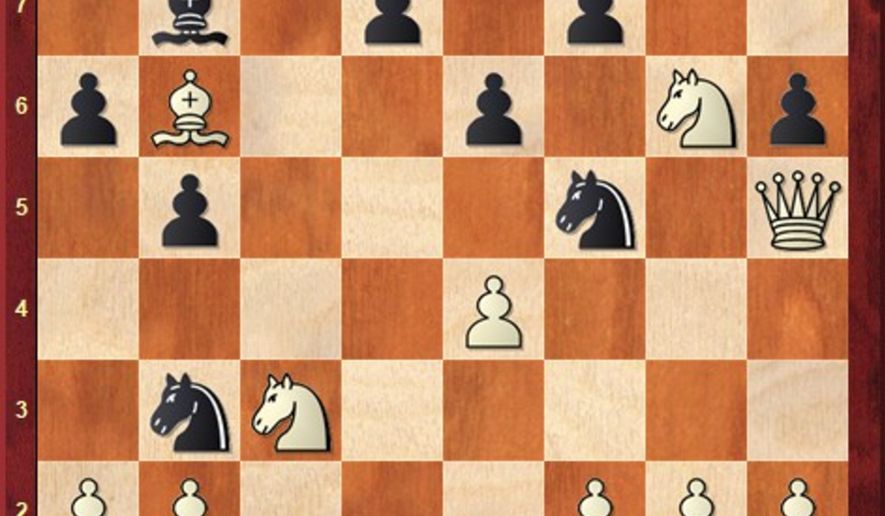
White gets her money’s worth out of a provocative Sicilian Smith-Morra Gambit line, with some sharp opening play and a plethora or mate threats right off the bat: 12. Ne5 Nxb3 13. Bb6! Qc8! (and of course not 13…Qxb6?? 14. Qxd7 mate) 14. Qf3 (threatening mate of f7) Nf5 15. Qh5 (renewing the f7 mate threat).
Goryachkin nimbly negotiates the tactical minefield now with 15…g6 16. Nxg6 (see diagram) Ng7! (a critical zwischenzug that turns the tables; taking the knight gets Black mated in such gruesome lines as 16…fxg6? 17. Qxg6+ Ke7 18. exf5 Nxa1 19. Ba5 Nc2 20. f6+ Kd6 21. Rd1+ Bd5 22. Rxd5+! exd5 23. f7+ Kc5 24. Bb6+ Kc4 25. Qxc2) 17. Qg4 Nxa1 18. Nxh8 d6 19. Qf4 Qd7 20. Rxa1 — the material balance has been restored, but White faces an enduring problem of extricating her knight from its prison in the corner.
Hng struggles impressively, but the knight is finally lost on 23. Ng3 Nf5! (taking into account the forks and counter-forks to come) 24. Nxe4! (less clever but equally unavailing was 24. Qh5 Nxg3 25. hxg3 Rb8 26. Be3 Qf5, and the knight is still trapped) Nxh6 25. Nf6+ Ke7 27. Nxd7 Kxd7 28. Rc1 Be7, and the White piece is finally lost.
White battles on, but Goryachkin finds the clearest path to victory on 36. h4 e4 37. g5+ Nxg5! 38. hxg5+ Kxg5, giving back the piece to reach a won rook-and-pawn ending. The connected Black passers prove an unstoppable force and after 42. Ke1 d4 43. a4 e3, White resigns facing lines such as 44. Kd1 d3 45. Rg4 e2+ 46. Ke1 Rc1+ 47. Kf2 e1=Q+ and wins.
(Click on the image above for a larger view of the chessboard.)
H. Carlsen-M. Carlsen, Arnold Grand Prix, Gausdal, Norway, January 2000
1. d4 Nf6 2. c4 e6 3. Nf3 b6 4. Nc3 Bb7 5. a3 d5 6. Bf4 Nbd7 7. Nb5 Rc8 8. Nxa7 Ra8 9. Nb5 Rc8 10. Rc1 Nh5 11. Bxc7 Rxc7 12. Nxc7+ Qxc7 13. cxd5 Qd8 14. dxe6 fxe6 15. Qb3 Bd5 16. Qa4 Be7 17. Ne5 Bf6 18. e4 Bxe5 19. dxe5 Bb7 20. Bb5 Ke7 21. Rd1 Bc8 22. Qb4+ Kf7 23. Qd6 Ke8 24. Qxe6+ Qe7 25. Qd6 Qxd6 26. Rxd6 Ke7 27. Bxd7 Bxd7 28. g3 Rc8 29. O-O b5 30. f3 Rc5 31. Rfd1 Be6 32. f4 Rc2 33. R1d2 Rc7 34. Rb6 Bc4 35. a4 bxa4 36. Rc2 Kd7 37. Rd6+ Kc8 38. e6 Nf6 39. e7 Bf7 40. Rd8+ Kb7 41. Rxc7+ Kxc7 42. e5 Ne8 43. e6 Black resigns.
Hng-Goryachkin, Gibraltar Masters, La Caleta, Gibraltar, January 2019
1. e4 c5 2. d4 cxd4 3. c3 dxc3 4. Nxc3 Nc6 5. Bc4 e6 6. Nf3 a6 7. O-O Nge7 8. Bg5 h6 9. Be3 b5 10. Bb3 Bb7 11. Re1 Na5 12. Ne5 Nxb3 13. Bb6 Qc8 14. Qf3 Nf5 15. Qh5 g6 16. Nxg6 Ng7 17. Qg4 Nxa1 18. Nxh8 d6 19. Qf4 Qd7 20. Rxa1 b4 21. Ne2 e5 22. Qxh6 Bxe4 23. Ng3 Nf5 24. Nxe4 Nxh6 25. Nf6+ Ke7 26. Nxd7 Kxd7 27. Rc1 Be7 28. Nxf7 Nxf7 29. Rc7+ Ke6 30. Be3 d5 31. f4 Bd6 32. f5+ Kf6 33. Rb7 Rc8 34. g4 Bc5 35. Bxc5 Rxc5 36. h4 e4 37. g5+ Nxg5 38. hxg5+ Kxg5 39. f6 Kxf6 40. Rxb4 Rc2 41. Kf1 Ke5 42. Ke1 d4 43. a4 e3 White resigns.
• Got a hot tip or a cool game to share? David R. Sands can be reached at davidrsands18@gmail.com.

Please read our comment policy before commenting.