


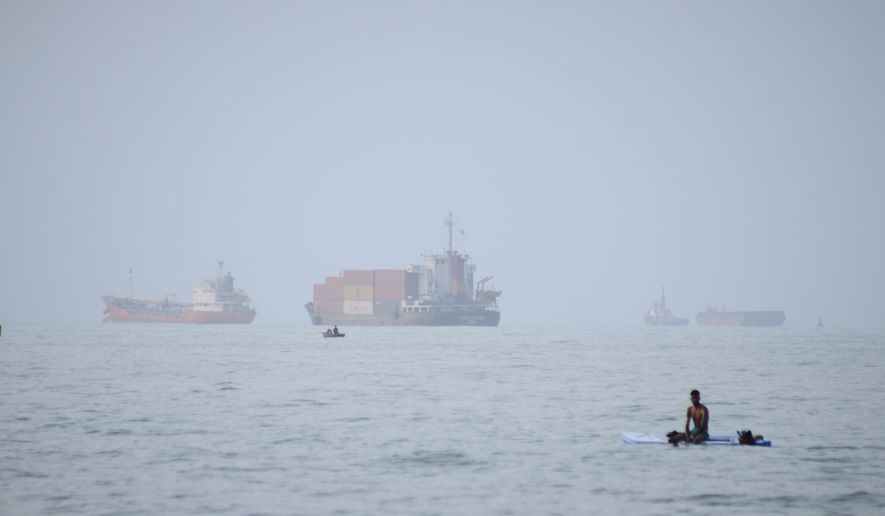

U.S. and Middle East officials said Tuesday that they were zeroing in on a deal with Iran to reopen the Strait of Hormuz, a potential return to normalcy that cheered oil investors and sparked records on Wall Street.
Oil prices dropped below $80 per barrel, down from more than $100 at the height of the Iran war, after Treasury Secretary Scott Bessent said he expected an agreement by midweek.
Mr. Bessent said returning the waterway to normal would benefit oil markets and a host of other sectors, including fertilizer and the chemical industry.
Secretary of State Marco Rubio pointed to progress in separate remarks, while Iranian officials said they made strides in consultations with Oman, the sultanate on the other side of the vital waterway.
The emerging agreement would call for ships to enter the Persian Gulf through an Iranian-controlled route and exit through an Omani-controlled route, regional officials told The Associated Press. However, the deal would be contingent on the U.S. lifting its blockade of Iran, a potential sticking point.
U.S. stocks had a banner day regardless, fueled by prospects of a breakthrough and strong earnings reports. The Dow Jones Industrial Average surged more than 900 points to close above 54,000 for the first time, and the S&P 500 also hit a record high.
Control of the Strait of Hormuz, a narrow channel between Iran and Oman, is an issue that must be settled to clear the path to deeper talks between the U.S. and Iran over Tehran’s nuclear program.
At least one-fifth of the world’s oil and natural gas supply travels through the strait annually, and its closure has driven up energy prices globally.
Tehran wants to maintain some level of control over the strait, citing clauses in a memorandum of understanding it reached with the U.S. in June.
The American side considers that to be a dead document, however, and says it is time for Iran to allow free movement in the strait, as international law has long required, and agree to give up hopes for a nuclear weapon.
While the U.S. speaks to Iran through mediators, Tehran officials engaged with Oman about “the future administration and maritime services in the Strait of Hormuz.”
Iranian Foreign Ministry spokesperson Esmaeil Baghaei told state-run media that the discussions are both political and technical and focus on determining “safe inbound and outbound routes for vessels.”
Mr. Bessent strongly suggested that Iran would be prohibited from charging a toll, a key point for global officials who say the strait must remain a free and open waterway.
“I think it would be freedom of movement,” Mr. Bessent said on CNBC. “Even though things are still a little dicey there over the past few days, we saw quite a few ships coming out even now. I’d expect the energy prices to settle back down.”
At its narrowest point, the Strait of Hormuz is only 21 miles wide and therefore would have no international sea lane for free navigation if Iran and Oman had the usual 12-mile territorial water rights.
However, under the U.N. Convention on the Law of the Sea, ships have a right of peaceful transit through such straits that, among other things, cannot require a toll.
Other such waterways include the Strait of Malacca between Malaysia and Indonesia, the Strait of Gibraltar between Spain, Morocco and Britain, and the Strait of Dover between Britain and France.
The situation is a bit of a jumble, despite optimistic rhetoric on the American side.
Iranian officials have insisted that they are not negotiating with the U.S., contrary to statements made by President Trump, who said this week that both countries were approaching a deal to open the strait and end the war.
The U.S. and Israel launched strikes against Iran on Feb. 28 with the main goal of constraining its nuclear ambitions, though Iran retaliated by striking U.S. allies in the Persian Gulf region and clamping down on the Strait of Hormuz.
The U.S. and Iran have gone through cycles of diplomacy and violence since then.
Mr. Rubio said preventing Iran from acquiring a nuclear weapon remains “the ultimate deal.”
“I think the immediate deal, the one that you see a lot of focus on, is the strait,” he said Tuesday at the State Department.
Mr. Rubio said some oil is moving through the Strait of Hormuz. However, he said mediators are speaking to Iran and Oman about moving more ships through the waterway safely “in the short term, as we go through these longer-term talks about denuclearization.”
“Suffice it to say there’s been progress made in those talks, but not finality yet,” Mr. Rubio said. “We’re hoping that will happen very shortly.”
Mr. Trump said Monday that he is giving diplomacy one last chance before he launches crippling strikes on Iran.
“I want to give them every last chance before decapitation,” Mr. Trump said in the Oval Office. “We’ll see what happens.”
Mr. Trump had been ready to launch a massive attack on Iran over the weekend, only to pull back upon the request of the Saudis and other Gulf partners, who want to mediate a deal with Iran.
“To do an attack that big on a country? I’d rather not do it,” Mr. Trump said. “Hopefully, they’ll come to their senses.”
The Foreign Ministry of Qatar on Tuesday said draft proposals are being exchanged between Iranian and U.S. officials, with mediators from Qatar, Oman and Pakistan facilitating the coordination.
Ministry spokesman Majed al-Ansari said the eventual goal is to “go back to the normal situation” in the region, particularly in the Strait of Hormuz.
Mr. al-Ansari declined to provide a timeline when pressed on when a deal could be announced but insisted it would be “as soon as possible.”
Meanwhile, the British Maritime Trade Operations reported that a projectile near the coast of Oman struck an unidentified cargo vessel.
Iran, which has carried out numerous attacks against commercial vessels in the strait over the last month, has not claimed responsibility for the strike.
Separately, Iran-backed Houthis in Yemen said they hit a target at an airport in Saudi Arabia, saying it was in retaliation for Saudis entering their airspace.
Contact the author



Please read our comment policy before commenting.