



OPINION:
A coalition led by the American Association of Colleges for Teacher Education recently called on Congress to provide $2.5 billion in workforce development grants and scholarships to address the teacher shortage. With more than 400,000 teaching positions nationwide currently unfilled or understaffed, the proposal is well-intentioned.
It is also exactly wrong.
The nation has a teacher shortage, but the solution is exactly the opposite of what experts most often propose. We need less credentialing, not more.
Think back to classic Westerns. Almost every film has a schoolteacher character. She had read every book in town. She knew her history, could parse a sentence, do sums in her head and quote Scripture from memory. The whole community sent their children to her and sought her counsel, not only because she had mastered reading, writing and arithmetic but also because she was a storehouse of wisdom of those few great books that found their way to her single-room schoolhouse.
The image of that schoolteacher endures in the popular imagination because it captures something true: The quality of the person matters more than the degrees they hold.
We have forgotten this lesson. Today, the primary pathway into American classrooms runs through colleges of education. Although America’s teachers are often passionate, hardworking and devoted to their students, this credentialing system provides them with inadequate preparation and excludes high-quality candidates.
A report from the National Council on Teacher Quality found that only 1 in 8 elementary teacher preparation programs nationwide devote enough time to teaching fundamental math content. The average graduate program dedicates just 14 hours of instruction to math content knowledge, less than a single course credit.
Ironically, teacher colleges are not primarily focused on what to teach — the history, literature, mathematics and science that students need to learn. They are training them in methods: pedagogical theories, classroom management frameworks and instructional strategies.
Methods matter, but they can be learned by an intelligent person with a deep understanding of an academic subject and a love for helping students develop that same understanding. What matters most is content knowledge, because you cannot teach what you do not know.
At its core, teaching requires two skills: knowing what you are trying to explain and being able to express it in a way someone else can understand.
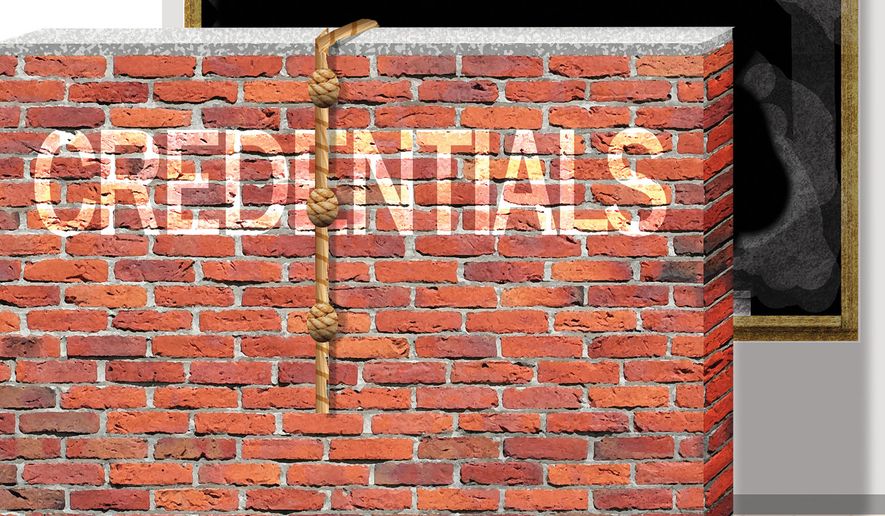
This exposes a central myth of our credentialing system: that teaching is a vocation reserved for specialized experts. Not only does the complex certification system leave credentialed teachers unprepared for the rigors of the classroom, but it also puts up obstacles for qualified candidates who otherwise know their subjects deeply and love to teach.
The data bears this out. During the COVID-19 pandemic emergency, Massachusetts temporarily suspended traditional licensing requirements, allowing candidates with a bachelor’s degree to teach while deferring certification exams. Researchers at Boston University’s Wheelock Educational Policy Center rigorously tracked the results. Emergency-licensed teachers — those hired without traditional credentials — performed just as effectively as fully certified new teachers on every measure of student outcomes. Nine out of 10 wanted to stay in the profession, and most principals wanted to keep them.
The emergency license, it turned out, was the answer to the crisis all along.
At Hillsdale College’s network of K-12 classical schools, we have operated on this premise for years. Although our schools operate within each state’s legal requirements and hire certified teachers where required, they seek teachers who demonstrate subject-area mastery above all.
What we look for is what has always mattered: deep knowledge of a subject, the ability to communicate it clearly, genuine care for students and the intellectual formation that makes a person worth learning from. Our schools are full of people who found their way to teaching from other lives — veterans, former lawyers, engineers and parents who simply love what they know and want to pass it on. They are among the finest teachers I have encountered in all my years working in education.
This is not an argument against training. A good mentor, a thoughtful principal and years in the classroom will make any intelligent person a better teacher, but methods are primarily learned by doing, not by sitting in a course.
To truly solve the teacher shortage, we should tear down the barriers that keep knowledgeable, talented people out of our classrooms — not erect more of them.
America has plenty of teachers. We just need to let them teach.
• Kathleen O’Toole is the associate vice president for K-12 education at Hillsdale College and a high school teacher at Hillsdale Academy.

Please read our comment policy before commenting.