


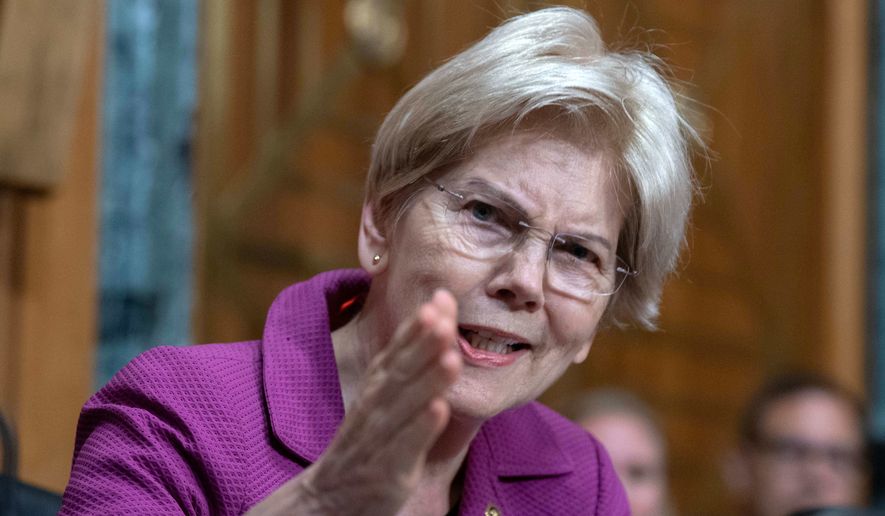

Sen. Elizabeth Warren wants to throw out the U.S. debt limit, and she credits President Trump with the idea of eliminating one of the only mechanisms that forces Congress to debate government spending and debt, which now stands at $39.8 trillion.
The debt ceiling is the federal government’s legal borrowing limit. Currently, it is set at just over $41 trillion, a level the U.S. is expected to reach sometime in 2027, according to projections from the Committee for a Responsible Federal Budget.
“Donald Trump is right about this: Eliminate the debt limit — its only real function is to threaten an economic crisis,” she recently said on social media.
Ms. Warren, a Massachusetts Democrat who backs more government spending to create “Medicare for All,” universal public college and student debt relief, told The Washington Times that she wants Mr. Trump to make borrowing without a statutory cap a reality.
“If President Trump would put his shoulder behind it, I think we could get it done,” she said.
White House officials are not entertaining Ms. Warren’s calls, nor is the administration planning to take up the debt limit in an upcoming budget reconciliation bill.
However, Mr. Trump previously suggested abolishing the debt ceiling altogether to avoid periodic political standoffs.
The national debt, which is growing at $7.7 billion per day, routinely hits the statutory limit. Failure to raise the ceiling leaves the federal government unable to borrow money to pay its bills, threatening a default that could trigger widespread economic damage.
Congress typically resolves debt limit standoffs at the last minute, though each showdown forces a brief debate over national deficit spending.
Ms. Warren said the limit fails to contain the debt and merely allows the party in the minority to use the threat of chaos as leverage. She is advocating for tearing down the ceiling as markets flash warning signs about the nation’s fiscal condition.
In July, 30-year Treasury yields rose to the highest level since 2007. This could lead to higher borrowing costs for the U.S.
Interest payments now exceed defense spending, pushing the Pentagon from its longtime spot as one of the three largest spending items in the federal budget. Annual debt payments are projected at roughly $1.1 trillion in fiscal 2026 — about 14% of the federal budget, according to the Congressional Budget Office. That trails only Medicare and Medicaid, at $1.7 trillion combined, and Social Security benefits, at $1.6 trillion.
Defense spending in fiscal 2026 stands at about $895 billion.
Maya MacGuineas, president of the Committee for a Responsible Federal Budget, said the growing national debt “has economic ramifications where it pushes up interest rates and inflation, making things more unaffordable … and it slows economic growth.”
She said the debt “means that you’re less able to respond to emergencies — like we did during COVID or the Great Recession when we were able to borrow — without pushing up interest rates.”
The U.S. hit the debt ceiling in 2023, forcing the Treasury to take “extraordinary measures” to prevent a default on its debts. Republicans, who controlled the House, used their majority leverage to demand spending cuts. They were in the Senate minority at the time.
Sen. Mark R. Warner, Virginia Democrat, said the recurring showdowns make him doubt the debt limit’s value.
“I think it’s been abused for political purposes,” he told The Times. “It’s not without some merit, but it’s not like it’s ever served as a constraint on raising the debt.”
There are no true safeguards to contain the debt, and the ceiling certainly is not a strong one, Ms. MacGuineas said.
“There’s basically none in place,” she said. “The debt ceiling, more often than not these days, gets increased along with actual additional borrowing.”
Republican fiscal hawks told The Times that they reject calls to eliminate the debt limit, which they see as a welcome restraint on otherwise boundless spending.
“I’d like to use it to try to reduce spending, so I like it,” said Sen. Rick Scott, Florida Republican.
Sen. Ron Johnson, the Wisconsin Republican who assumed leadership of the Senate Budget Committee after the July 11 death of Sen. Lindsey Graham, said he is wary about eliminating the debt limit.
“I know that’s what President Trump would want, for sure,” he said. “There’s got to be some leverage for fiscal responsibility at some point in time. I’m somewhat sympathetic with that, but [we’ve] got to figure out some way to reduce the deficit.”
Republicans may raise the debt ceiling before the next Congress to prevent Democrats from gaining leverage over the White House if they win control in the November midterms.
In July, Mr. Trump called on Republicans to swiftly address “the ever-looming debt ceiling disaster.”
Senate Majority Leader John Thune, South Dakota Republican, indicated that Republicans would not take up a debt ceiling increase anytime soon but might do so after the midterms.

Please read our comment policy before commenting.